Monday, September 28, 2009

Wellington Rural Romp


It seems like weeks since my boyfriend and I have been able to spend any time together, just the two of us. So, what could be better than jumping in the Jeep and driving all over Wellington County for the third annual Rural Romp.
The romping started bright and early this morning with a trip to the Guelph Farmer's Market. Since I go to the market every Saturday morning, this was just a quick trip to grab the weekly necessities. Many food stuffs are at the end of their season and I was lucky enough to get a couple of large baskets of roma tomatoes. They make a delicious homemade tomato sauce. We visited our new friends at Backyard Bounty, grabbed enough greens for the week, and headed out on the open road. First stop, Mapleton's Organic.
Mapleton's Organic was the furthest away so we thought we'd start there. I love driving in the country in the autumn. The colours are spectacular.


There wasn't much going on at Mapleton's so Alex and I walked around and looked at the animals. We spent some time hanging out with the cows, goats, alpacas and the pig. I really wanted to pick up some yogurt but we had a long day ahead of us, and it was a little early for ice ceam. Unfortunately, we didn't get to talk to the owner of Mapleton's. A reported from Cogeco News was setting up to interview him. I hope to return another day, when time permits a conversation. Mapleton's Fat Free Plain Yogurt is, afterall, my yogurt of choice.


From Mapleton's we headed to Shepherd's Watch 100 Mile Market, where we met Carol. Alex and I had very recently talked about how cool it would be if there was a local market that sold entirely local food stuffs. Here it was, in the heart of Arthur, Ontario.


Shepherd's Watch carries local produce, meats, pastas, grains and artisan cheese and yogurt. They also sell wool products, country photography and hand knitted crafts.
Their market doubles as a cafe where they serve homemade meals made from real farm food. What a great idea!! Carol urged us to visit Lynda at their farm. We purchased two coffees (Fair Trade coffee from Birds and Beans in Toronto), as well as some Bison, Wild Boar and Blueberry sausages. We'll be having them for dinner tonight. We said our goodbyes to Carol and made our way out to Shepherds Watch Farm to meet Lynda.


When we arrived at the farm another couple was just finishing a tour with Lynda so we wandered around and checked out the sheep. They seemed to know no boundaries, wandering freely all over the property. bawling at one another when left alone. Lynda took us on a fantastic tour, introducing us to the fascinating world of sheep farming. I was especially interested in the cheese making process. I will save the details for a blog which will be entirely devoted to Shepherd's Watch. For now, I'll say that we thoroughly enjoyed Lynda's company. She was knowledgeable and friendly and I look forward to writing the blog about their operation soon.

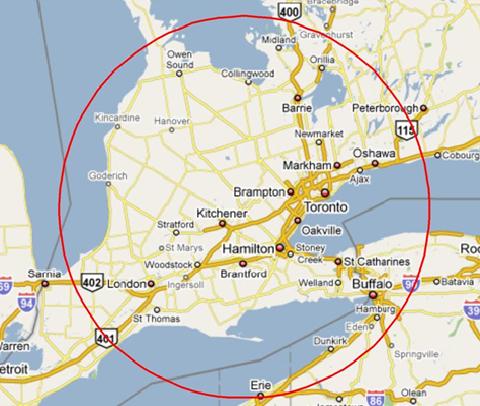
From Shepherd's Watch farm, Alex and I headed down Hwy. 6 toward Cox Creek Cellars. What romp is complete without a little wine tasting? I had never tried Cox Creek wines, let alone visited their cellars. For obvious reasons, a winery is a popular stop on a rural tour. We weren't surprised to see that it was busy when we got there.
After looking over the list of available wines, Alex and I selected a few that we wanted to try. First on the list was Russet Fantasy, an apple wine. It was light and crisp and delicious. In the whites, we also tried Cox Creek White and Peach Symphony. Since we had just bought a large basket of peaches at the Farmers Market earlier that morning, we chose the Peach Symphony to accompany a near future dessert that I had yet to plan.
For the reds, we selected three wines; Oak Barrel Aged Blackberry Wine, Cox Creek Red (made from the Baco Noir Grape) and the Pinot Noir, a Chestnut barrel aged grape wine. Personally, I found the blackberry wine far too sweet for my tastebuds. We chose the Pinot Noir. It was light but flavourful and would make a wonderful accompiament to some future 100 Mile meal. The young lady who served our wine was informativew and sweet. We opted to skip the tour since there were a lot of people there and I prefer a more one-on-one meeting where I can ask a lot of questions without an audience. Alex and I decided that we would return to Cox Creek another day. There will be an entire blog devoted to Cox Creek in the near future.
From Cox Creek we headed to Magda Farm, but on the way the Jeep decided it had had enough of the Romp. Somewhere on Fourth Line, between County Road 22 and 20, it overheated. We found ourselves stuck in the middle of nowhere, cold and hungry, in the pouring rain. Luckily, Magda Farm was literally a 2 minute drive away. We opted to stop there and tour around while the Jeep's engine cooled.
I had very recently sworn off grocery store meat for good. I don't like the idea that I don't know if hormones or antibiotics were used on the animal. I don't know what the animal has been eating and I don't know how it was treated. All of these factors play an important role in the decision making process when it comes to purchasing meat. When we stumbled upon Magda Farm we found everything we were looking for. Vegetarianism, while an easy choice for some, proved to be difficult for Alex and I. We are not afraid to admit that we eat and love eating meat... but not just any meat.


Since we were the last to grace her farm, we had Vera all to ourselves. She took us on a tour of the farm to show us the animals. While we walked she explained their farming methods, some fixed, some experimental. What was clear was her passion. She obviously loves what she does and really cares about the animals well-being. Magda Farm offers eggs from free-range hens, pasture-fed beef, free-run pork, as well as some roasters. The animals are hormone and antibiotic free and their feed is 100% non-GMO. Look for a future spotlight on Magda Farm. Alex and I had a really nice time chatting with Vera, but since the Romp was technically at its end, we purchased some eggs and meat and hit the road.


I'd like to tell you that this story ended happily, but it didn't. Somewhere just past Magda Farm, the Jeep decided that it had had enough of our day of romping and stopped. We had to be towed along the back roads to a mechanic. All in all, it was a wonderful day though. Alex and I met some wonderful people and learned a lot. Yay! for Rural Romp 2009!

Friday, September 25, 2009

Homemade Yogurt


Ever get tired of those silly yogurt commercials? You know the ones... the ones that promise all sorts of digestive and weight-loss miracles, while some scantily-clad, flat stomached woman wiggles her hips like Shakira? Right. Yogurt can do all that. And then there's the 'probiotics' craze, which much like the '0 trans fat' craze, has people buying food stuffs that they wouldn't normally buy just because it contains more or less of this new important dicovery. I like to think that I am above these marketing schemes but, alas, I am not. I, too, got caught up in the probiotic craze, with high hopes that my digestive tract would be clean as a whistle. One day, I was carefully reading each yogurt container's list of ingredients while my poor boyfriend leaned against the cart yawning. I must be the most annoying person to live with when I get on a kick. I check and re-check all the ingredients, getting more and more anxious over things I don't even understand. Shopping takes twice as long as it should. And then he wearily asked, "And what exactly are probiotics?" Ummmm. Errrrr. Uhhh. Sigh... "I don't know".
The truth is, what used to be simply yogurt has become pretty complicated over time. The choices seem endless: fruit and flavour added, fat-free, low calorie or no sugar added. Additives include vitamins, omega 3's, probiotics, artificial dyes, preservatives, sweeteners (both natural and artificial), flavour enhancers, thickeners and stabilizers. How do we ever know which one to choose?
The health benefits of yogurt are many, so don't give up on it out of sheer confusion. Yogurt is rich in calcium and promotes excellent colon health, while helping to reduce the risk of colon cancer. The live cultures in yogurt help to increase absorption in calcium, which, in turn, helps prevent osteoporosis. Make sure to read your yogurt label closely if you are buying store bought yogurt. Some yogurts are heat treated, which may increase shelf life, but kills helpful bacteria. Look for the words 'live' or 'active' so that you know the bacteria is living and functional.
Yogurt is rich in protein, B vitamins and essential minerals, and low in carbs. If made from skim milk, yogurt is also low in fat. It is good for those who are lactose intolerant because it contains lactase, the enzyme needed to properly digest lactose.
The beneficial bacteria in yogurt may help digestion, but in order for them to work properly, yogurt must be consumed daily. I start every morning off with a fresh fruit and yogurt smoothie, sweetened with local honey.
Personally, I got so tired of comparing yogurt labels that I decided to make my own. At least this way I would always know what was in it.
In order to make your own yogurt you need to start of with a good base. You can order starter packs of culture or you can use already made yogurt. I opted for the latter. It took me a while to find the perfect yogurt to use as my base, but I found it. I use Mapleton's Organic Fat Free Plain Yogurt. It is made with 6 live cultures, pasteurized organic skim milk and non-fat dry milk. You can use your own yogurt to start your next batch, but you can only use it once. Starter batches do freeze, however, so if you really wanted to save some money, your first entire batch of yogurt could be devoted to making and freezing starter batches. I am just not that organized or patient. I simply buy yogurt from the Stone Store or somewhere else that sells organic fat-free plain yogurt and take it from there. One container makes about 4 batches, with each batch consisting of six 8 oz containers. Below is the step-by-step process for making your own yogurt at home (taken from the instruction manual for my Waring Pro Yogurt Maker). You can make yogurt without a yogurt maker, but I considered it a life investment.

PLAIN YOGURT
4 3/4 cups low-fat (2%) milk
1/2 cup plus 2 tbsps dry nonfat milk
1/2 cup plus 2 tbsps plain yogurt

Heat the milk in a saucepan over medium heat. Once milk reaches 185 F (85 C) and is about to boil, remove from stove and allow to cool to 110 F (45 C). To speed up the cooling process, whisk liquid frequently or place saucepan in ice water.
Once liquid reaches appropriate temperature, whisk in dry milk and the yogurt until ingredients are thoroughly homogenous.
Pour liquid into individual jars. Place jars into the yogurt maker without their lids. Cover the yogurt maker and set for 8 to 10 hours.
When the yogurt maker signals that the yogurt is finished, cover the jars with their lids and store in the refrigerator. Yogurt will keep refrigerated for up to one week.

Monday, September 14, 2009

Pears, pears and more pears...

Oh, how I love Saturday mornings at the Farmer's Market! It has become a ritual best enjoyed alone. I say this not because I don't enjoy the company of others, but because I like to take my time. I like to take in the sounds and the smells without distraction, allowing them to inspire creation. I like to get there early. Every Saturday, I walk the entirety of the market, outside and in, before making a single purchase. I don't want to miss a thing. Who's got the best deals this week? Who has the nicest looking produce? Who has something new that I haven't tried before? All of these details are important. Since I decided to preserve as much as possible this year, it is very important not to over or under purchase produce. It is also very important to pay attention to what's in season and what might not be there next week. This is the first time I have done this and I missed certain seasons out of pure ignorance, simply because there are no seasons at the grocery store. I have learned to pay attention to the finer details. The first peaches to appear at the market were like large rocks in a basket. I waited. Same thing for the apples and corn. Strawberry season has long since passed, yet there are still strawberries for sale. I avoid these. During the few weeks that blueberries were in season, I purchased a few 6L baskets and spent a day washing and freezing them. Once you learn to shop in season, food actually gets cheaper. This Saturday was no different than any other. I purchased large quantities of apples, corn, tomatoes and peaches. Luckily, I had my boyfriend there for the first trip. We got the heavy stuff out of the way and then I returned, empty-handed and ready for my ritual.
On the first time round I passed an older gentleman who, in a thick German accent, asked me if I wanted to buy some of his pears. He looked at me so kindly and asked me so sincerely that it was hard to refuse. I asked him about his pears. They were both local and organic and, most surprisingly, dirt cheap. He was selling a giant box of pears for the low low price of $10!!! Since I had already been home with the larger produce and had just returned for the small stuff, I told him that I would have to get him next week. But Helge was only here this week as the pears were in season now. I'm a country livin' bus kid and my house is a good 25 minute walk from the closest bus stop. There was no way I could carry these pears home. He smiled at me, understanding my dilemma. I said my goodbyes and continued with my morning, besides what was I going to do with a giant box of pears? I spent the next 20 minutes justifying the cost of a cab to myself.
I guess you already know what happened next... Of course, I bought the giant box of pears. He tossed in a 4L basket full of pears ready to eat straightaway. I was now in possession of more pears than I had eaten combined in the past 6 years! Oh my! What was I thinking?
Once home, I plunked the box on the floor and sat down to think. I'd can them... or as many of them as possible. Make a soup... freeze some. We'd have pears all winter.
Tip to future preservers: Don't purchase more than you are capable of doing alone!
I spent a good 8 hours preserving that Saturday. Between the apples that were made into apple sauce and peeled, cored, sliced, blanched and frozen, the corn that was shucked, and the tomatoes that were reduced to a thick and zesty sauce, I barely made a dent in the box of pears. By the end of the day, I had a mere 4 500 ml jars of preserved pears. Since then, some have been pawned off on neighbours, disguised as gifts. Some have been eaten in salads and as snacks. Some were made into a delicious soup. The rest are hidden in the pantry, out of sight but never out of mind. Anyone want some pears?
For anyone who is interested in getting their hands on their own $10 giant box of pears, please send me a message. I did get directions to Helge's farm, as well as his phone number.
Here are some of the things that you can do with pears:

CANNING
For each 1 L jar, select 2 to 3 lb ripe, mature fruit. Harvest pears when full grown. Store in a cool place until ripe but not soft. Wash, peel, halve and core pears. Place in a colour protection solution. Pears may be packing in water, apple or white grape juice, very light or light syrup.
HOT PACK- Prepare syrup and bring to a boil in large stainless steel saucepan. Drain fruit and place one layer at a time in syrup; return to boil or until fruit is heated through. Pack hot fruit into jars and add hot syrup. Repeat for remaining fruit.
Heat process: 500 ml jars - 20 min.; 1 L jars - 25 mins.; 1.5 L jars - 35 mins.
(Taken from the Bernardin Guide to Home Preserving)

ROASTED PEAR SALAD WITH BLUE CHEESE

Roast pear in 350 degree oven for 20 mins. Peel off skin, if desired. Slice.
Fill a salad bowl with mixed greens. Sprinkle with sliced almonds and crumbled blue cheese. Toss and place roasted pear on top. Drizzle with caramel dressing.

CARAMEL APPLE DRESSING

In small dish, mix caramel sauce, olive oil, apple cider vinegar and black pepper until it tastes sweet, but slightly tart. And, yes, there is a 100 mile recipe for caramel sauce. Here is the link for anyone who is interested: http://100mile.foodtv.ca/recipe/100-mile-caramel-sauce


PEAR AND PARSNIP SOUP

2 tbsp canola oil
2 cups peeled parsnips, sliced
1 cup peeled carrots, sliced
1 lg. onion, diced and sauteed
4 1/2 cups water
2 pears, peeled, cored and diced
1/2 tsp cinnamon
1/4 tsp. nutmeg
salt and pepper to taste
Toss parsnips and carrots in oil and roast in 350 degree oven for 25-30 minutes, or until soft. Sautee onions. Add roasted veggies and pear. Add water and seasonings. Bring to a boil. Allow soup to boil continuously for quite some time. Take off heat and puree in batches in a blender. Return to pot and stir.
Serve with crumbled blue cheese on top.
(I added vanilla soy to mine to make it a bit creamier and it tasted wonderfully smooth and rich)

Wednesday, September 9, 2009

Summer Greens, the cure to onset Winter Blues

If you're anything like me, the mere thought of a winter without greens leaves you panicked. Don't panic, there is a solution!!

A few weeks ago, I got the idea in my head that maybe I could grow greens at home. Uncertain if this was even possible, I set out to do some research. When starting any new project I always head out to a bookstore to see if they carry something on the subject. On that day I happened upon Microgreens: A Guide to Growing Nutrient-Packed Greens by Eric Franks and Jasmine Richardson. It was exactly what I was looking for.

Microgreens first outlines what materials you will need in order to grow greens in the comfort of your own home. Trays, soil, seeds, towels, sprayers, and a pH meter are just a few of the things you will need. I read the book, cover to cover, in one night. My addiction to arugula made me do it!
Next step: purchasing the necessary means to grow greens at home. For this, I spent a good hour on a Saturday afternoon pestering Ryan Hetner at Organic Botanic with a million questions. He patiently answered them, knowledgeably and thoroughly. In the corner of his shop, under rows of grow lights, there were trays of greens (including my prized arugula), living proof that I wasn't just a dreamer. Ryan pointed to different plants, while passing me samples of his greens for tasting. As expected, they were delicious! I promised that I would return after the first of the month, once the boxes in my new country home were all unpacked.
When I returned for my things, I chose 3 packages of seeds; arugula, beets and a spring mix of broccoli, radish, red clover and alfalfa. The seeds are packaged by a company called Mumm's and they are organic. And here lies another 100 mile dilemma; the seeds are packaged in Saskatchewan. I justified buying the seeds because there were no local, organic seeds available for purchase and I will be growing them at home, well within the 100 miles. I am supporting a Canadian organic seed company, as well as a local independent business. Since there are so many criterion to consider here, it is understandable that decisions may be difficult to make. Just do what feels right. As far as I know, there are no 100 mile police out there. I found a PDF online which lists other seed suppliers. If you wish to do further research, here is the link: 
http://www.cog.ca/documents/SeedlistingWI06.pdf 
The list does contain a seed company which falls within the 100 miles; Sproutmaster in Elmvale, Ontario. I contacted the owner and asked about the seeds. She told me that the seeds were from all over North America and if I were to include individual seed types, she would happily tell me their origin. Sproutmaster's website is: http://www.sproutmaster.com/. The email address for Mumm's, should you wish to write them with similar queries, is: http://www.sprouting.com/.
The health benefits of greens cannot be overstated. Arugula, for example, is a readily absorbable source of calcium, iron, manganese, copper and potassium. It is also a good source of vitamins A, C, K and folic acid and it is high in both Omega 3 and Omega 6 fatty acids. On top of that, arugula is considered to be one of the most potent anti-cancer foods.
I have tried to see how much nutritional value is lost during travel, to no avail. Major fruit and vegetable companies, like Dole, don't provide information on the origins of their products on their website. I have written a letter to them but I don't expect a reply. One can assume that, much like other fruits and vegetables, they are at their nutritional best directly after harvest,and rapidly lose nutritional value soon after. Personally, I like the idea of cutting my greens fresh and consuming them immediately after. I know what kind of soil they were grown in (organic) and that they were not sprayed with chemicals. The pH of my water was tested and modified, allowing for optimum plant growth. The greens I planted mere days ago are happily reaching their little arms to the skies. Every morning they are significantly taller. By the end of this week I will be consuming salad greens that I grew myself. This summer I was buying my greens from Fourfold Farms and Backyard Bounty, both located at the Guelph Farmer's Market. Now I'll be eating them right out of my windowbox. How's that for local?


Tuesday, August 25, 2009

100 Mile Beekeeping


On Monday morning I met Mark McAlpine and his wife, Shelly. I met Mark when a friend of mine told me that he had raw, local honey for sale and thought I might be interested in getting my hands on some. Where there is honey, there are bees. Where there are bees, there must be a beekeeper.

I must admit that I knew absolutely nothing about bees but have always been fascinated by them (see Blog #1).So, I contacted Mark and asked if he wouldn't mind showing me his little backyard operation. He readily agreed and I found myself walking there on a nice sunny morning in the prime of honey harvesting time.

Mark and Shelly were instantly likeable. With a cute little house, built in the early 1900's, filled with books and animals, I felt instantly at home. The backyard was an abundance of green which smelt like a fragrant mixture of damp earth and sweet honey. Shelly pointed out where there used to be a compost heap. Now it was a mess of green leaves and giant orange flowers. Her compost heap was sprouting squash and pumpkins! Tomatoes of various shapes and colours grew everywhere. I love a garden with a natural feel. Further back were tables filled with a variety of bonsais in different stages of growth. Bonsais exude a magical presence. I always feel like I'm part of some special secret when I'm around one. Then I saw them, the beehives. The beehives, just to clarify, were not like the ones you see in the Berenstein Bear books or classic Winnie the Pooh tales. What they looked like was a stack of small, wooden sock drawers, piled one on top of the other, like a poorly contructed dresser. But inside those drawers (I think the proper term is 'frames') there were no socks... only honey. Sweet and delicious honey.

Before we could do anything, we had to dress properly for the occasion. I put on what looked like a safari hat, and then pulled over mesh netting which covered my face and shoulders. Apparently bees are drawn to small black dots, much like the pupil of your eye. This is probably because they look like the iris of a flower or an entrance to something. Although I felt no fear, which truly surprised me, I happily donned the beekeepers attire. Mark's bees are Caucasian or Russian bees, and Buckfast bees. There is an interesting Wikipedia article on Buckfast bees and their history, if anyone wants to learn more.
Because it was still early in the morning, the bees were just getting up and making their way out into the world in search of nectar. For this reason, we had to smoke them out. The smoke makes them relax, which makes them easier to handle. With enough of the bees smoked out, it was safe to take a closer look.
Mark held up a plastic tray, called a super, which looks like a prototype of honeycomb. The bees use the super to build small wax cavities called honeycomb. They store their honey in the individual cavities and then seal them off. This is called capping. When a super is fully capped the bees will move up in the hive and fill more. The beekeeper has to be very careful that he does not allow the bees to fill everything, otherwise they will feel cramped and, eventually, they will swarm. Swarming occurs when the hive splits in two to begin another hive. In order to curb this swarming mentality, Mark removes frames from the hive, and replaces them with fresh ones for the bees to fill. This keeps the bees busy and us in honey.
Bees have an extremely interesting social order which, I will admit, I don't completely understand. The bees are reigned over by a queen. The queen is twice the size of the other bees and is the only one in the hive to reproduce. Drone bees (the males) are basically sperm sacks. They are there merely to mate with the queen. Come winter, they are not even allowed in the hive. Females are the worker bees. These are the bees which pollinate our flowers and make honey. They are protected by guard bees (I never asked their sex), who protect them from wasps and invading bees. Bees from other hives will invade if they sense that the hive is vulnerable. A queen bee typically rules the hive for 2-3 years, after which she is switched out for a younger queen by the beekeeper. Worker bees cannot work up to the status of a queen. A queen is simply born a queen. Near the end of her reign, a beekeeper will notice changes in the hive, one being an overproduction of drone bees (those useless sperm sacks!), as well as the underproduction of the valuable worker bees. Since the hive is a working unit which relies heavily on its workers, an overabundance of drones can be detrimental to the survival of the hive. In the winter, bees do not hibernate, but do stay inside the hive. They stay awake, keeping themselves warm by constantly moving. The bees on the outside of the hive will move into the middle, while those in the middle will move outwards, much like the penguins in March of the Penguins. Being innately neat creatures, bees' excrement will not be found in the hive, even after a long winter. The bees will wait until spring to relieve themselves outdoors. A sure sign of spring can be found in the yellow excrement in the snow on a warm spring day.
Bees are fascinating insects and, like many of Mother Earth's creature, they are in danger. Bee populations are under strain due to pesticide use, as well as cell phone towers. I have not read enough on the subject to confidently continue, but will certainly do some reading when I get a chance. Mark did tell me about a bee-related epidemic which occured some 5 years ago, now referred to as Colony Collapse Disorder. There are some interesting articles on Colony Collapse Disorder online, if anyone is interested.
After having a peek in the hive and holding up a super for close inspection, we let the bees get back to work and headed to the screened in porch for the second part of the operation. On the porch there were frames full of supers, fully capped and full of honey. Mark asked me to remove one, which was surprisingly heavy. He took what looked like a cat comb, and gently scraped the top of the caps off. Once the caps were removed, we put the super into a hand-powered honey extractor. I spun the handle, watched the honey fly out of the combs and run down the walls. Next, we poured the honey through a strainer into a large plastic container with a spigot attached to it. The honey was strained one last time through cheesecloth before it slowly filled the 1 L mason jar beneath it.
This was a fascinating and educational morning. I learned a lot from Mark and for this I am extremely grateful. I left with a litre of delicious honey, a container of honeycomb, and a big smile on my face. Mark's bees, for my curious 100 mile diet fans, collect nectar from a 3 mile radius. They're about as local as you can get!

Friday, August 21, 2009

More preserving tips...

Blueberries, Strawberries & Raspberries
Perhaps the easiest to preserve, berries are a delicious treat in the winter. I'm a smoothie junkie, so there are always berries in our freezer.
Wash the berries thoroughly. With blueberries all you need to do is look for the bad ones and pick out the stems. For strawberries, I just cut the tops off altogether. Raspberries are a bit more delicate. Wash under a light spray but don't soak. Soaking raspberries makes them turn to mush really quickly. I always lightly shake the berries in a colander until most of the water comes out. Put them into large freezer bags and remove the excess oxygen from the bag using a straw or, like me, you can just put your mouth to the back and suck the extra air out that way. Probably not the most sanitary of methods but Alex doesn't care...
Freeze and enjoy later!
Beans (Yellow and Green)
Beans are also fairly easy to preserve. Simply wash the beans thoroughly in a colander. Cut off ends and cut into approximately 2 inch pieces. Blanch beans for 3 minutes in boiling water. Remove and rinse under cold water. I freeze mine in 2 person sized portions. Always date label your food; frozen blanched vegetables last up to 12 months in the freezer.
Broccoli, Cauliflower & Carrots
Once again, wash, wash, wash. Cut broccoli and cauliflower into medium sized pieces. Peel and slice carrots. Everyone will have their own method. I filled a bowl with enough mixed veggies for 2 and then blanched them in batches. Blanch for 3 minutes in boiling water and freeze in individual portioned bags or one big bag. Date label. Enjoy!
Bell Peppers (Green, yellow, white and red)
I use bell peppers when I make soup, in stews and in a variety of other ways. I've never frozen them before, but I clearly remember my mother freezing bags of them. She froze them whole and I remember finding them in the bottom of the freezer, crushed and freezer burnt. I thought I'd try something different.
Wash peppers thoroughly. Cut off tops and gut. Cut into rings. I froze them in mixed bags with a few rings of each colour. I still don't know what I'm going to do with them but they make me smile everytime I see them in the freezer. They're bright and cheerful and they're going to be delicious in the middle of the winter.
PS Peppers don't need blanching, just straight freezing.

Thursday, August 20, 2009

100 Mile Mel's 100 Mile Disclaimer

I was having breakfast with a friend this morning and we were talking about canning. He playfully mentioned that my colour treatment recipe contained an ingredient which was obviously not from anywhere around here; lemon juice. The syrup I made to keep the apricots and peaches in contains sugar, which may have been refined just down the road in Toronto, but whose main ingredient is definitely imported. We laughed about this over coffee (Yes, coffee!) and then I really thought about it... so I'm writing this disclaimer, lest other, more serious, 1oo-mile dieters come after me.


DISCLAIMER

I am not perfect. I am a work in progress. I did not start this journey in order to practice what I already know. I started this journey in order to learn and share knowledge. I want to know how the honey gets into the honeycomb, and then into the jar. I want to know how flour is milled and what potatoes look like when they're in the ground. There's so much to learn. Most of all, I want to know what I'm putting into my body and where it has come from. Wherever possible, I want to know the people who provide me with what I consume. I'd like to thank them.
So, although there are certain things that I could go without, I don't want to. There, I said it. I don't want to. I want lemons. And olive oil. And vinegars. And coffee.... delicious coffee. And spices from India. I will buy organic wherever possible. I will buy local, wherever possible. I will buy fair trade. But I won't sacrifice everything.
Just for the record, I can be pretty fanatical about something if my interest is piqued. I read so many books on Africa that my poor boyfriend started wincing when I picked up a new one. I knew it was time to move on. I do not want to become one of those patronising, old farts who complains when the rest of the world doesn't jump on the same train that they do. These changes will take time. You might even see me in the grocery store, sneaking around in the produce section, looking desperately at 'fresh' greens. I might even buy them, until I find a way to grow them myself...
Enough said. If you have suggestions, kindly drop me an email and I will consider them. In the meantime, let me enjoy my coffee... :)